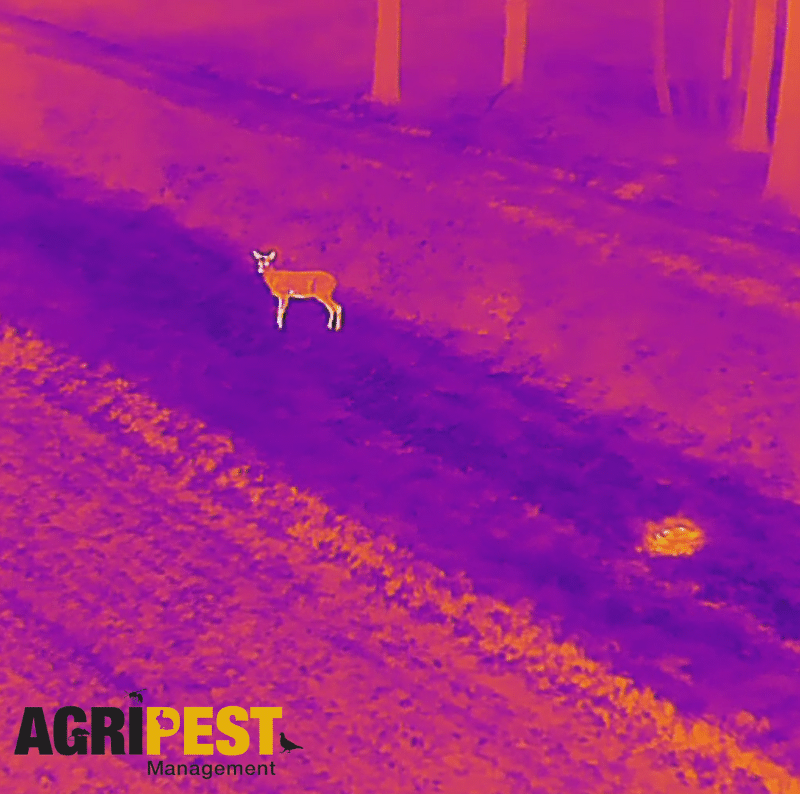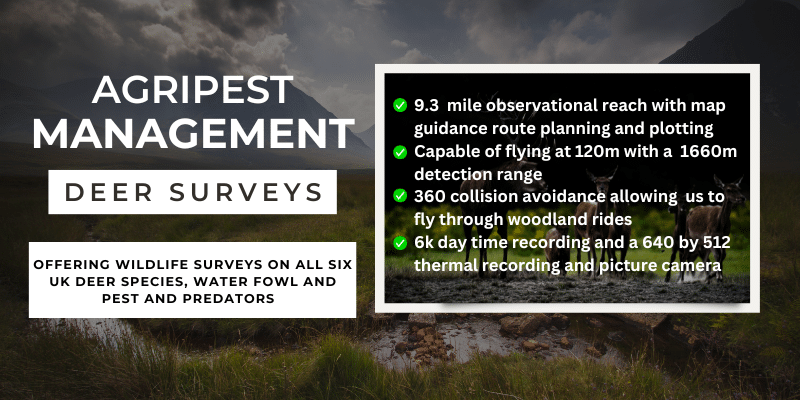
Remote Sensing Technologies: Employing technologies like thermal drones, or thermal imaging to detect and estimate deer populations.
These surveys are vital for understanding deer population dynamics, habitat preferences, migration patterns, and overall health. The data collected from such surveys aids in wildlife management, conservation efforts, and making informed decisions regarding cull quotas or habitat preservation initiatives.
Why are Deer culls important?
A “deer cull” refers to the selective and controlled reduction of the deer population in a specific area. It’s a management strategy often employed when the deer population exceeds the carrying capacity of the ecosystem or when there are concerns about overpopulation causing ecological imbalances, damage to habitats, agricultural losses, or increased risks of disease transmission.
Utilising the latest thermal technology will significantly speed up Deer counts while providing detailed results, our thermal drone also allows us to locate, plot and monitor deer numbers within a specific area.
Controlling Deer
Shooting deer for management purposes, such as in culling programs, is carried out by trained AgriPest team members, our aim is to maintain balanced wildlife populations within an ecosystem. These culling activities often occur in areas where deer populations have exceeded the ecosystem’s carrying capacity or where overpopulation poses risks to habitats, agricultural lands, or human safety.
It’s crucial to emphasize that stalking and culling activities should be conducted responsibly and ethically, with a focus on safety, sustainability, and the humane treatment of animals. AgriPest Management work to ensure that all stalking and culling practices align with conservation goals and the long-term health of both the deer populations and their habitats.