Expert Mole Control in Yorkshire
AgriPest Management is a professional mole removal company. Fully certified and accredited, you can expect satisfaction, fast turnaround times, excellent flexibility and a friendly service.
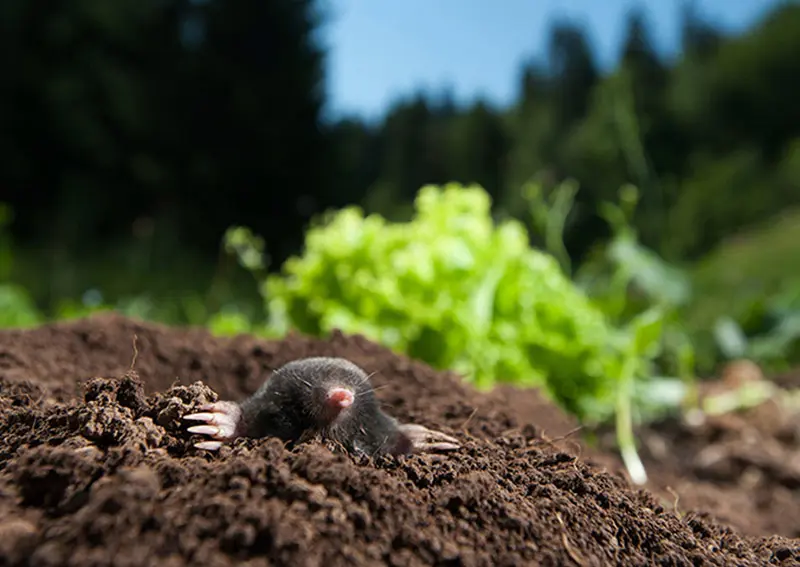
The mole is the only mammal to live solely underground. They can achieve this by having a greater proportion of red blood cells compared to other mammals, and this is how they survive in an environment with low oxygen levels. Moles are solitary animals spending most of their lives alone, other than in breeding season. They are territorial with their own individual tunnel systems.
The moles found in the UK are known as the common mole or European mole (Talpa europaea). Moles are insectivores feeding on a diet mainly of worms but they will feed on other insect larvae. A mole will need to eat half its body weight each day to survive, this could be up to 20 worms each day!
Moles are typically black in colour, although other colours such as grey, orange and even white have been recorded. Moles often grow to an average of around 15cm in length, and weighing between 110 and 120 grams.
The average mole often lives to around 3 years of age, but it is possible for them to live to 6 years of age.
Moles have very large, well adapted paws with 5 claws on each paw which they use to dig their tunnels with.
Although moles are small they are very powerful for their size and are able to move up to 540 times their body weight and tunnel up to 200 meters each day!
Although many people think moles are blind, they are actually not, they are just very sensitive to light but can see movement, they are however colourblind. Moles have ears that are located internally behind where their shoulders are. They have an incredibly sensitive nose or snout which acts like a sound tube, picking up scent and vibration. They have sensory hairs around their body which help them navigate their dark tunnels, as well as using their tails to feel for vibrations.
A male mole is known as a boar and females known as sows, young moles are known as pups.
Breeding season occurs from February to June, during breeding season the male mole will extend his tunnel systems to new territories to look for females to breed with. Once the male has mated with the female, a nesting chamber is constructed and lined with plant material.
The gestation period of a European mole is 30 days, after this period the female mole will give birth to 3 or 4 hairless pups. These pups will have grown hair by around 14 days of age. The pups will feed off their mother until around 4 or 5 weeks of age at which point they are weaned and can leave the nest at around 33 days old.
From 5 to 6 weeks of age the mole pups leave their mother completely and go to live their solitary lives and construct their own tunnel systems.
Moles work in a 4 hour system meaning they will feed and tunnel for 4 hours and then sleep for 4 hours. This is a process that is repeated over a 24 hour period.
Moles will dig permanent tunnels that are usually 8 to 12 inches below the ground, these are the tunnels that the mole will live and feed in the majority of the time. They will also dig temporary tunnels whilst searching for food, these tunnels are often really shallow and near to the surface of the ground.
What are the signs of moles?
Moles activity is often incredibly easy to spot as the soil that they excavate from their tunnels is pushed above ground forming a visible mole hill. Mole hills vary in size, some can be incredibly large. Very large mole hills are known as fortresses.
Moles build a fortress in areas with shallow soil where they can’t dig deep tunnel systems, or in areas that can be prone to flooding. The fortress has an internal structure containing tunnels, nesting areas and food stores.
On occasions you may not see any obvious mole hills, but you may see their shallow tunnels close to the surface of the ground, really shallow tunnels often appear slightly protruding under the grounds surface.
Moles can make a huge mess of gardens and fields with their tunnels and mole hills. Many people believe flattening moles hills will make them go away, however this is not true because the mole will simply push more soil up to the surface the next time it has to excavate its tunnel system and a new mole hill will appear where the old hill was flattened.
How are moles controlled?
The most effective method of controlling moles is by trapping. Mole trapping is a very skilful method of control and often takes time and experience to master and get good results. Other methods of control include gassing, however this is an ageing method which isn’t used as much today due to the restrictions involved with the use of gassing as well as the fact that the method has mixed results of effectiveness.
Here at Agripest the only method of mole control that we use is trapping due to its effectiveness and the fact you can physically tell once you have caught the mole in the trap.
Moles are caught by digging down to the moles tunnels and placing traps in the tunnel systems. These traps will intercept the mole as it is traveling down the tunnel and as the mole hits or pushes its way through the trap it will trigger the trap and humanely dispatch the mole.
A dibber or probe is used to locate the moles tunnel systems. The dibber is essentially a long, thin rod that is pushed into the ground to feel for the tunnels.
Once a tunnel has been located and the trap has been set and installed, it is then back filled and is now ready to trap the mole. Traps are marked with flags so we know where each of our traps are located for when we come back to retrieve them. Mole traps are checked every 24 hours and any moles that are caught are removed from the trap.
After we are confident that we have dealt with the problem moles, we lift the traps and backfill the holes. You will not be able to tell where the trap has been other than a small patch of soil, and after a short period of time grass should start to grown back.
Many different types of mole traps are available for use in different situations and conditions. Some trappers prefer different types of traps over others and people will get different results with different traps and after a bit of experience using each trap, trappers will often find a preferred trap that suits them and what they feel confident in using.
Some of the different types of mole traps available include:-
-Barrel or duffus mole traps.
-Trapline mole traps.
-Talpex mole traps.
-Putange mole traps.
-Easy set mole traps.