The rabbit (Oryctolagus cuniculus) is a small mammal which can be found throughout the UK. Although they are a naturalised species, rabbits aren’t actually native to the UK as they were introduced by the Norman’s in the 12th century as a source of food and fur. They have since become an extremely well-established species, and as a prey animal they provide an important food source for many native animals such as foxes, stoats and birds of prey.
 Rabbits are very easily identified with their brown and grey fur, long ears and fluffy whitetail. They can grow up to 40cm in length and weigh anywhere from 1.2kg to 2kg. The average lifespan of a wild rabbit is up to 3 years, although many are lucky to make it to this age.
Male rabbits are known as bucks, females are known as does and baby rabbits are known as kits or kittens.
A female rabbit is ready to breed at 4 to 5 months of age. After mating the gestation period of a rabbit is 31 days, after which the female rabbit will give birth to a litter of up to 12 young. After the doe has had her young she can become pregnant again just a few days after! One doe can have several litters in a year. The breeding season for rabbits is from January to October, although wild rabbits are known to breed year round in some circumstances.
Rabbits live in burrows known as warrens which are dug out generally by the female rabbits. A rabbit warren can range from just a few holes to a large, elaborate network of tunnels depending on the size of the colony. The tunnels are interconnecting and will include living quarters, nesting areas and emergency exits known as bolt holes which they will use to escape from predators such as stoats.
Although rabbits provide an important food source for native predators, they are also a prolific pest in the agricultural, equine, commercial and domestic industries. Rabbits will graze on crops and grassland and can cause a large amount of damage if they are present in numbers. Their urine can kill off grass and their droppings can be an obvious nuisance in settings such as gardens. Rabbits dig a lot which can also cause a lot of damage. They can cause land collapses, wall collapses when they undermine them and can also pose a risk to livestock potentially breaking their legs in rabbit warrens. Rabbits can also cause a lot of damage to young trees by chewing a ring of bark off around the base of the tree which will eventually kill the tree, this is an obvious threat in settings such as arboretums, orchards, vineyards, etc.
How do we control rabbits?
There are a few different methods of which we use to control rabbits. One of the most effective methods, providing it is done at the right time of year is ferreting. Ferreting is a traditional, but very effective method of rabbit control. The art of ferreting involves putting one or more ferrets into a rabbit warren. The ferrets will then chase the rabbits out of the Warren and into nets placed by us. There are 2 main types of nets used when ferreting. These are purse nets and long nets. Purse nets are placed over the holes in the warrens and are secured into the ground with a peg. As the rabbit bolts out of the Warren, it hits the purse net which tightens up around the rabbit, catching it and allowing us to humanely dispatch the rabbit. Long nets are large nets which are set up surrounding the Warren. As the rabbits bolt out of the Warren they hit the long net and get tangled in the netting allowing us to humanely dispatch them. Long nets are ideal for use when ferreting large Warren systems when a lot of ground needs to be covered, and where using a large amount of purse nets is impractical. They are also good for surrounding warrens where vegetation such as brambles are an issue and the use of purse nets would be impractical due to snagging. Although purse nets are very effective, they can only catch one rabbit at a time, you have to remove the rabbit and reset the purse net each time which can not only be time consuming if ferreting a large Warren, but it can also result in losing rabbits if more than one rabbit bolts out of the same hole at one time. This is why purse nets are more suited to smaller warrens, or warrens where long nets can not be used due to solid ground or obstructions such as trees, sticks or vegetation which can get tangled in the long nets.
Long nets are extremely effective as they can catch multiple rabbits at a time and there is no need to reset them after each rabbit like you would with a purse net. They can cover a lot of ground but can require a bit more time to set up and pack away than what purse nets would. Generally, you would use long nets when ferreting land such as grassland where there is little obstruction to the nets as sticks and vegetation can easily become entangled in the long nets and it can then be time consuming and frustrating to untangle them.
Ferreting is a great form of rabbit control due to the fact that no chemicals are used in the process, and it is generally a fairly fast and quiet method of control as opposed to trapping where you need to check traps daily, and can only catch one rabbit per trap, then  having to go and remove the rabbit from the trap and reset before catching another rabbit. Ferreting is a good method of rabbit control where trapping and shooting can’t be used due to environmental conditions.
Ferreting is a seasonal method of rabbit control and Is normally carried out in the winter months when rabbits do not have young in the warrens. If you went ferreting during the warmer months you risk the ferrets catching the vulnerable young in the Warrens. The ferret will then eat the young and could possibly stay in the Warren for hours which is an obvious disadvantage when carrying out a job. Another reason why ferreting is carried out during the winter months Is the rabbits spend a lot more time in the warrens so you are a lot more likely to catch them, as opposed to in the warmer months when rabbits will spend most of their time outside of the Warren so you would be less likely to catch them.
Shooting can also be an effective form of rabbit control if you are permitted to do so. Generally shooting is carried out in the agricultural and equine settings where large areas of land allows us to do so safely, however some domestic settings have large gardens where shooting can also be an option. When controlling rabbits by shooting, the most effective time to do so is night time, as rabbits are mostly nocturnal and are likely to be out at this time. The use of a lamp, which is known as lamping to spot the rabbits in the dark so they can be identified and shot humanely with the use of a rim fire such as the 22lr or 17hmr which we most commonly use. In smaller areas of land where we wouldn’t be able to shoot the rim fire safely, an air rifle can also be used, however range is limited to about 30 yards and is not as effective as the rim fires which can humanely dispatch rabbits up to sensible ranges of up to 100 yards with the 22lr and 150 yards with the 17hmr.
If lamping can not be carried out due to the customer not wanting lamps flashing around on a night, we can use night vision which is mounted onto the scopes of the rifle and allows us to see what we are shooting at in the dark without the need for a lamp.
Trapping is another form of rabbit control which we can use, however it is not as effective as ferreting and shooting and is often more time consuming due to having to check traps at least every 24 hours (twice a day, once in a morning and once in an evening is recommended). When using traps it is important to check regulations and use approved traps. We most commonly use the Mk 6 Fenn traps to trap rabbits which we set in the entrances to the warrens. As the rabbit is entering or exiting the Warren, it steps on the trap which catches it. If set correctly the trap should instantly kill the rabbit, however rabbits can occasionally get trapped by a leg which will not kill it, and this is why it is important to check traps daily in case a rabbit in a trap needs humanely dispatching.
The use of snares can also be an effective way to trap rabbits. Snares are set on the rabbit runs which can be above ground, going under fencing etc. The snare is set at just the right height so that when the rabbit jumps through it, the snare will tighten around the rabbit and hold it in place for the pest controller to come and dispatch the rabbit, snares are not designed to kill the rabbit as some people think, they are a way of catching and holding the rabbit ready for the trapper to come a long and humanely dispatch. It is important that the snare is set correctly at the right height for targeting rabbits, this will ensure that no non target species are accidentally caught. When using snares it is important to use legal snares with stops on the snare. These snares are designed to only tighten up to a certain point so they do not cause strangulation if a non target species were to end up in the snare. For this reason, snares need to be checked at least once every 24 hours (twice each day is recommended).
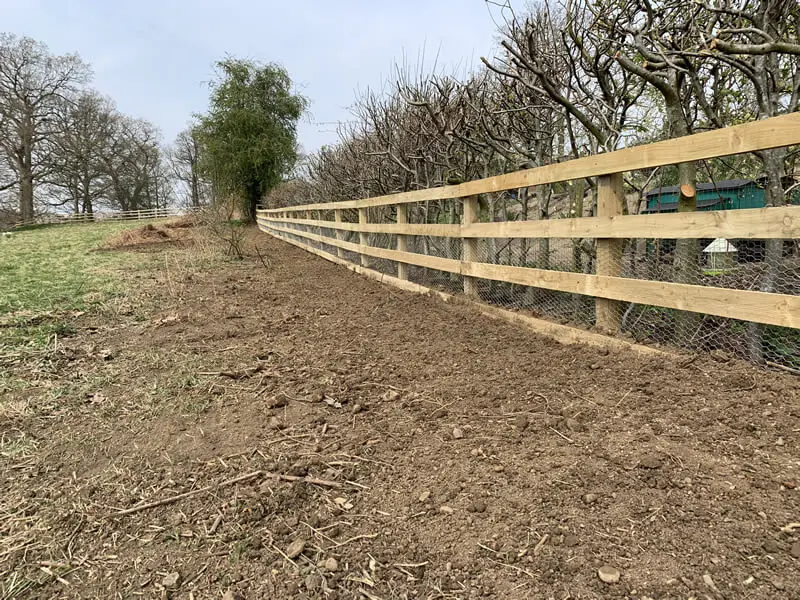 Another form of rabbit control (or exclusion from property) is rabbit proof fencing. Rabbit proof fencing is an extremely effective way of stopping rabbits from accessing property. Rabbit proof fencing is most commonly installed with the use of post and rail fencing (although other types of fencing can also be used). A trench is dug a foot and a half deep along the area where the fencing is going to be installed. After digging the trench, the fencing is then erected in line with the trench and rabbit proof fencing wire is attached to the fencing and runs to the bottom of the trench. After the fencing has been installed and the wire attached, the trench is then filled in level with the ground. You then have a barrier that runs the length of the fencing which will stop rabbits from accessing the property. Rabbits will not be able to jump the fencing, they also will not be able to dig underneath the fencing due to the wire being buried a foot and a half deep, generally, rabbits will not try to dig to this depth to get under the fencing.
Rabbit proof fencing is installed after rabbits have been cleared from the property, it is a barrier to exclude any more rabbits from entering the property in the future.